|
This week, we were assigned an article to read: “From the Mind’s Eye of the User: The Sense-Making Qualitative-Quantitative Methodology” by Brenda Dervin. I found it so hilariously ironic that this article was about sense-making, yet I struggled to no end in making any kind of sense out of the article itself. At first, I thought I would tackle this right away and get the assignment out of the way. I read the first page or so about 5 times and then put it away. I tried the first few pages again, then put it away again and did as much as I could on all the other assignments. I searched some images. I searched some reviews. I read the subtitles and looked at all the graphics. Then I used my day off to hunker down and push through it. As I read, I asked myself the following questions (apparently a very important part of sense-making): -Is this about database construction? -Is this about research? -Is this about meta-reality? -Is this about psychology? -Is this about sociology? Although there were sections of the article that seemed to quickly veer off into a different direction, I think the author’s overall intention was to explain the process of sense-making, and perhaps its potential value to research. As I read, to help myself remember things that I actually understood, I highlighted and took notes. The main theme I was able to identify was the description of the sense-making process. Sense-making is an individual process that humans use to gain information, solve problems, understand. Each person constructs their own understanding through this process that is unique to his/her own experience. Each path to each new understanding is as different as a snowflake. In my search for images, I chose the simplest one I could find: 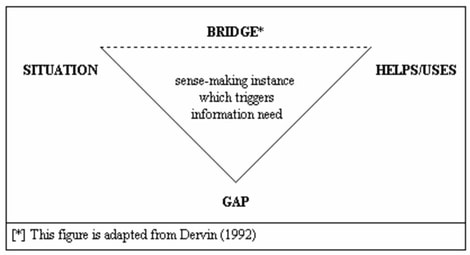 Image taken from: http://www.cios.org/EJCPUBLIC/009/2/009215.html
I like this image because it demonstrates the main idea of the article and because it is clear. This best demonstrates how I bridged the gap between confusion about this article and making sense of it! So very meta. In fact, I don’t think I’ve ever read anything as meta as this in my life. If I had the job of helping high schoolers, or even adults, through this reading, I’d definitely have to read it several more times myself. Perhaps I would read more of her work to gain a better understanding. My first thought is that I would definitely chunk it into small sections and go slow. I would use the image I chose and reflect back on it frequently to reconcile each section to the main idea. I would probably search out articles, videos, podcasts by others on the same topic to see if anyone else was able to explain it more clearly or simply. I think this process was a great experience for teachers to understand how students might feel when they are asked to read something that is way above their lexile level. Just the fact that I put it off so long because it was difficult helps me sympathize with students who often give up when things get too hard.
8 Comments
Monica
2/16/2019 03:25:08 pm
Jona, thank goodness for you! I read through this article and I wanted to claw my eyes out. You have such a positive spin about struggling students and ways to sit with tough information. I like what you said about sense-making being ways to gain information, solve problems and understand the situation. That made sense to me in a very simple form.
Jona Sandau
2/17/2019 11:03:40 am
Monica, you are so kind, and so funny! Your comment made me crack up! Now I'm excited to go through and read everyone's blog posts on this!
Tess Giner
2/16/2019 08:25:06 pm
I read Dervin's article several times. It is extremely dense and confusing at times. However it is very fascinating at the same time once you get the gist. I really appreciated your blog because of not only your honesty, but your perseverance to figure out what the heck the article was all about. You were able to explain sense-making very well. Good job!
Jennifer Perkins
2/16/2019 09:11:43 pm
Hi Jona! You did a great job clarifying the main points of what we read this week, especially your summarization of the description of the sense-making process. I really liked the image you chose with the bridge forming between the situation and the helps/uses. I agree that it would be necessary to chunk this information into small sections and slowly review it before presenting it to others.
jlovie
2/18/2019 11:09:26 am
Jona I agree with you this was very challenging and many brain cells grew. I agree that the bridging of the gap was a key point.For me the part that made this such a challenge was sensemaking needed to bridge the gap is not really things we focus on in education. I do think this is part of the revolution/ innovation we see developing in education which makes this learning exciting and relevant. The understanding of the individual and their sense making process is something to ponder.
Brandon DeJesus
2/18/2019 05:21:03 pm
Hey Jona, so good to run into you and your family at the movies this week! I am glad that I was not the only one who struggled with this reading and found it ironic that making sense of sense making is harder to do than one would think. I like that you pointed out the constructivist themes referenced in the article. The other reading we did this week in Baggio explained Constructivism in a way that made this article more clear to me.
JP
2/18/2019 10:28:01 pm
I like how related sense making back to our research! so many times as I was reading article after article trying to make sense of what the researchers were trying to achieve in relation to my own driving questions. 2/18/2019 11:29:33 pm
Hi Jona Leave a Reply. |
Jona SandauI'm a student in the Innovative Learning Master's Program at Touro University. I'm really excited to make a difference for my students! Archives
March 2019
|
 RSS Feed